Cameras that understand safety rules. And explain every event.
Describe your safety rules in plain language — the system monitors them 24/7 on your cameras and explains every detected violation. Before it becomes an accident.
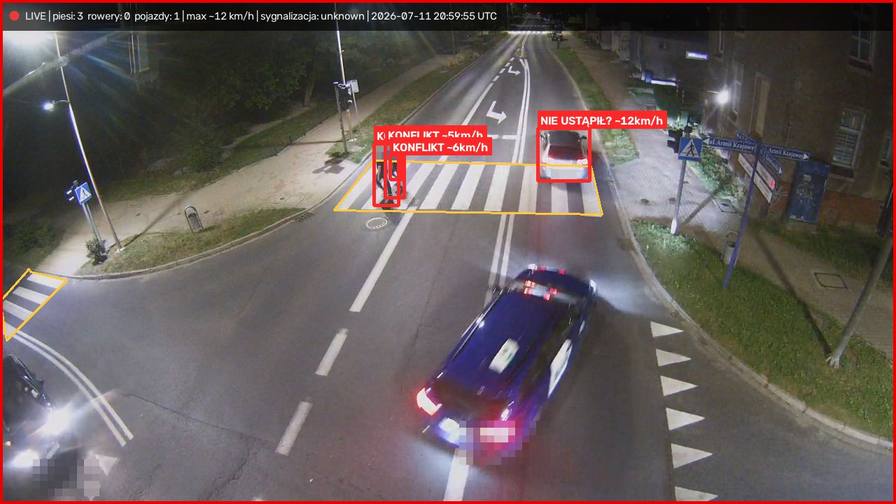
The driver of the passenger car drove through the pedestrian crossing while pedestrians were already on the zebra, forcing them to adjust their movement or proceed with caution. The vehicle failed to yield to pedestrians entering and occupying the roadway, which constitutes a traffic violation.
An accident starts with a small thing nobody noticed
- A guard physically cannot watch 30 screens at once.
- A safety specialist cannot be on every shift and in every zone.
- Most near-miss situations are never recorded anywhere.
of workplace accidents in Poland in 2024 were attributed by GUS to improper worker behaviour — something spot inspections cannot catch, only continuous observation can.
GUS 2024 (Portal BHP) ↗people were injured in workplace accidents in Poland in 2025 (preliminary GUS data), including 189 fatalities.
GUS 2025 ↗Safety rules in plain language — not code
- 01
We connect your cameras
Your existing CCTV is enough. Cameras missing in the right places? We will advise and help install them.
- 02
You describe rules in plain language
“Everyone in zone A must wear a helmet.” That is the whole rule deployment — no photo datasets, no model training.
- 03
The system detects and explains
Every event is a video clip plus a written justification: what happened and why it is a violation.
- 04
A human confirms
Your designated employee accepts or rejects reports — the system learns the specifics of your site.
Every event with a justification, not just an alarm
An alert without context is another sound everyone ignores. Our system describes each event in text — a record both a lawyer and a foreman can understand.
The driver of the passenger car drove through the pedestrian crossing while pedestrians were already on the zebra, forcing them to adjust their movement or proceed with caution. The vehicle failed to yield to pedestrians entering and occupying the roadway, which constitutes a traffic violation.
live example on road cameras
- A video clip of the event — not a frame taken out of context
- A verdict with a written justification
- Human verification status
- Faces blurred before anyone sees the footage
The engine is already running. Watch it live
Why are you seeing road cameras instead of a factory floor?
Because we don't have access to anyone's factory cameras — and we believe that's how it should be. Instead of staging a scripted demo, we run the very same engine on public road cameras: live, 24/7, on unpredictable footage, and you can verify every verdict yourself. At your site it will be your cameras and your rules — pedestrians and vehicles on a road are the same class of problem as people and forklifts on a shop floor.
What we teach the system — violation catalogue
Filter by facility type — each violation shows how it is written as a single rule.
- Missing safety helmet“Everyone in zone A must wear a helmet.”
- Missing hi-vis vest“Everyone in the transport zone wears a vest.”
- Missing goggles or ear protection“At the grinder station — goggles and ear muffs.”
- Entering a fenced-off zone“Nobody crosses the yellow barrier at the press.”
- Dangerous proximity to a forklift“A person and a forklift in the same zone at the same time = alert.”
- Internal transport speeding“Forklifts in hall B never exceed 6 km/h.”
- Work at height without protection“Above 1 m — harness clipped to an anchor point.”
- Standing under a suspended load“Nobody stands under the crane load.”
- Blocked emergency exit“A pallet on an escape route for more than 5 minutes = alert.”
- Obstructed walkways“Pedestrian walkways in the hall always clear.”
- Smoking outside the designated area“Smoking only in the shelter by gate C.”
- Phone in the vehicle traffic zone“In the forklift zone — phone in the pocket, not in hand.”
- Machine work without lockout (LOTO)“Maintenance only with the lockout padlock applied.”
- Person down / lying motionless“A person lying down for more than 10 seconds = immediate alert.”
- Person on site outside working hours“After 10 pm nobody should be in the hall.”
- Improper rack storage“Loads never protrude beyond the rack outline.” (in development)
This list is open-ended. If you can describe a violation in one sentence — the system can learn it. Together with your designated employee.
The designated employee: your person teaches the system your plant
Every plant is different. A generic AI doesn't know that your yellow line means one thing and the red one another. That's why we don't sell a black box — the system comes with a method that makes your person stronger.
- 01The system reports an event
- 02The designated employee confirms or rejects
- 03The system learns the plant's specifics
- 04The employee gains the full picture of violations
- Sees 100% of events from all cameras — not just what a walk-around happened to catch
- Gets ready-made material for safety trainings: a clip plus an explanation is a ready case study
- Becomes the in-house expert in AI-supported safety
We don't replace safety people. We give them eyes on the whole plant — at once.
Privacy built in: we analyse situations, not people
Anonymisation by default
Faces are irreversibly blurred before anyone sees the image. No identification, no biometrics, no face recognition.
Data serves prevention, not punishment
The system reports situations and zones, not individuals. Results are not used to evaluate specific employees.
Compliant with labour law
Worker safety is an explicitly permitted purpose of workplace CCTV under art. 22² of the Polish Labour Code. We help you deploy correctly: work-rules entries, employee information, site signage, DPIA support.
Designed for GDPR and the EU AI Act
Privacy by design: data minimisation, transparency, humans make the decisions.
A pilot in three steps
- 01
A call and selection
Together we pick 2–4 cameras and the first rules to monitor.
- 02
Configuration and learning
We configure the system and train your designated employee. The system learns your rules.
- 03
Results review and decision
After the agreed period we review the results together. Pilot terms are agreed individually.
No cameras, or in the wrong places? Not a problem — as part of the pilot we will advise and help install the right ones.
The Polish ZUS accident insurance premium depends, among other things, on your accident record — the risk-category adjustment reaches up to 50%. ZUS — accident insurance guide ↗
Frequently asked questions
Do I need to replace my cameras?
No. The system works on your existing CCTV. If cameras are missing in the right places, we will advise and help install them as part of the pilot.
Does the system punish employees?
No. We report situations and zones, not people — faces are blurred and the data serves prevention and process improvement, not evaluating individuals.
Why does the demo show road traffic instead of a factory floor?
Because we don't have access to anyone's factory cameras — and we believe that's how it should be. The demo shows the same engine on difficult, unpredictable public footage. At your site it will be your cameras and your rules.
Does footage leave the site?
We match the deployment model to your requirements — including a variant where the analysis runs on infrastructure designated by the client. Details are agreed at the pilot stage.
How long does a pilot take to start?
The start is picking 2–4 cameras and writing the first rules — days, not months. The exact schedule is agreed on the first call.
Does the system work in Polish?
Yes. You describe the rules in Polish and get every event explained in Polish. English is available too.
We'll show it on your cameras
Leave your contact details — we'll come back with a proposal of 2–4 cameras and starting rules.